
Apparently, "Be Kind" Still Applies When People Are Getting on My Nerves
Staying Awake, Chossing Compassion, and Learning What It Really Means to Be a Child of Light.
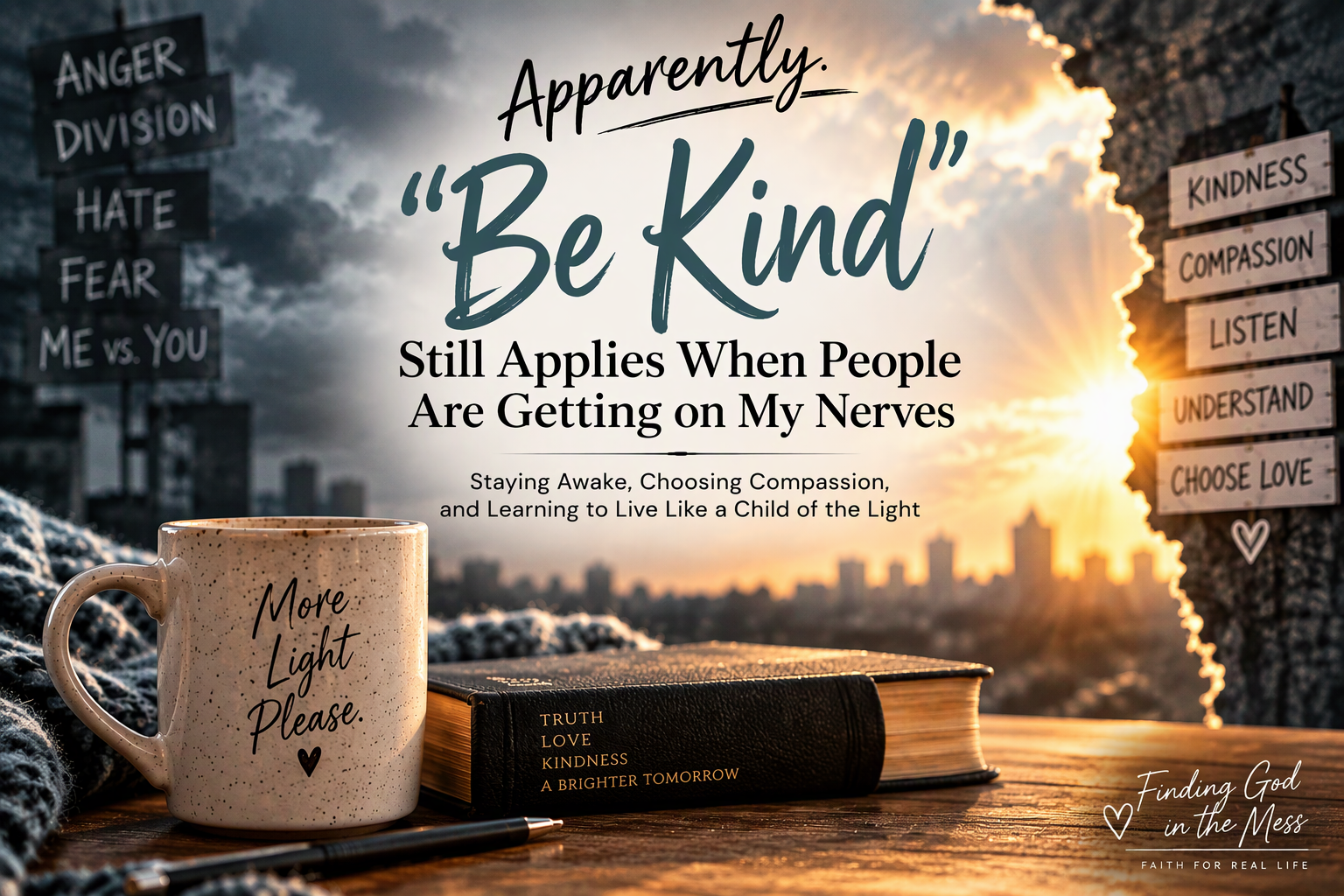
“Be kind and compassionate to one another, forgiving each other, just as in Christ God forgave you.” Ephesians 4:32
“You are all children of the light and children of the day. We do not belong to the night or to the darkness. So then, let us not be like others, who are asleep.”
1 Thessalonians 5:5–6
I have discovered that I am remarkably good at being kind when nobody is getting on my nerves. Patient? Absolutely. Compassionate? Practically glowing. Forgiving? Look at me, growing in grace.
And then somebody says something that makes my eye twitch.
Suddenly Ephesians 4:32 feels a little less like a comforting Bible verse and a little more like God has been reading over my shoulder. Because kindness is easy when kindness costs me nothing. It gets harder when I feel misunderstood. When somebody has said something cruel. When I disagree deeply with the person across from me. When I've read one too many headlines, spent a little too long scrolling, or watched people who should know better treat each other terribly. Those are the moments when I discover whether “be kind and compassionate” is something I believe or just something I like printed on things. And lately, I've been thinking there is a connection between Paul's words in Ephesians and his warning to the Thessalonians. Be kind. Be compassionate. Stay awake. You are children of the light.
Maybe staying awake spiritually isn't only about noticing the darkness around us. Maybe it's also about noticing when that darkness starts changing us. That's the part I don't like quite as much. I can recognize cruelty when someone else is being cruel. I can spot division while scrolling through a comment section. I can shake my head at the anger, the name-calling, the complete inability to disagree with another human being without treating them like the villain in a Disney movie.
But am I paying attention to what all of that is doing to my own heart? Because if I'm not careful, I can become so convinced that I'm standing against darkness that I don't notice myself carrying a little of it with me. I can become harsher. More suspicious. Quicker to judge. Slower to listen. And somehow I can convince myself that it's okay because I'm right. Ouch.
Paul doesn't tell us to be children of the light only when the people around us make it easy. And Ephesians doesn't say, “Be kind and compassionate to one another, provided everyone is behaving themselves and has recently apologized.” Honestly, that would have been a much easier verse. Instead, we're given a way of living that looks radically different from much of what surrounds us. Kindness. Compassion. Forgiveness. Light.
None of those things mean pretending that wrong is right. Compassion doesn't require abandoning truth. Forgiveness doesn't mean harm doesn't matter. And loving another person doesn't require agreeing with every choice they make. Jesus managed to hold truth and love together perfectly. The rest of us are still working on it. But perhaps that's exactly why Christians cannot afford to sleepwalk through this moment. The world is very good at discipling us into outrage. It rewards immediate reactions. It encourages us to sort human beings into teams. It tells us that listening is weakness, compassion is compromise, and anyone who disagrees with us must be our enemy.
Then Scripture interrupts.
Be kind.
Be compassionate.
Forgive.
Stay awake.
Walk in the light.
Not because darkness isn't real. Because it is. Not because truth doesn't matter. Because it does. But because the people of God were never called merely to identify everything that's wrong with the world. We were called to live differently in the middle of it. And I need that reminder as much as anybody. I need it when I'm reading the news. I need it when I'm frustrated with someone. I need it before I hit “reply.” I need it when I would much rather prove my point than preserve the humanity of the person standing on the other side of it.
Sometimes carrying the light looks dramatic. But I suspect most of the time it looks remarkably ordinary. Pausing before we react. Listening before we assume. Choosing words that don't wound simply because we know they could. Offering compassion when anger would be easier. Forgiving when we're tempted to keep rehearsing the offense. Remembering that the person across from us was created by the same God who created us.
That kind of life may not get many clicks. It probably won't win every argument. But it might help a hurting person recognize Jesus. And maybe that's the question I need to carry with me: When people encounter me, do they leave with more light than they came with? Because the world has enough darkness. This is no time for the Church to sleep. And it is certainly no time for those of us who have been called children of the light to forget how to shine.